
Cholesterol is often discussed when we talk about heart health, but maintaining healthy cholesterol levels is not about avoiding one particular food alone. Overall diet, the types of fats we consume, physical activity, body weight, genetics and lifestyle habits all play a role.
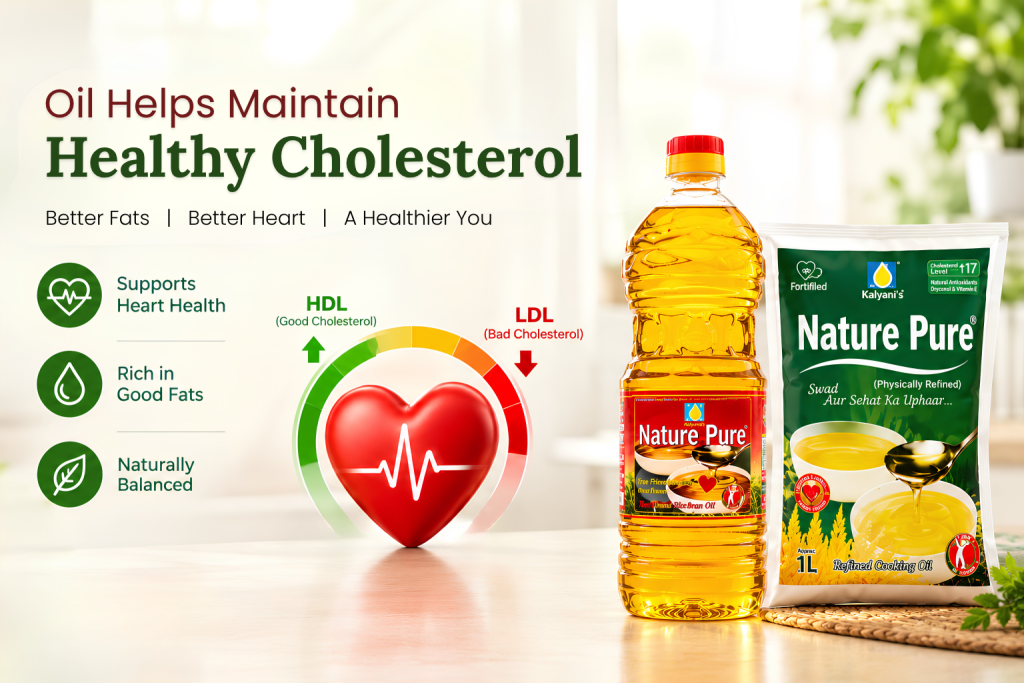
One simple place to start is the kitchen.
Because cooking oil is used regularly in Indian households, choosing an oil with a favourable nutritional profile can be part of a heart-conscious eating pattern. Rice Bran Oil is one such cooking oil that has attracted nutritional research because it contains unsaturated fatty acids and naturally occurring compounds such as Gamma Oryzanol, phytosterols and Vitamin E compounds.
Research has found that rice bran oil consumption can have favourable effects on some blood lipid measures, particularly total cholesterol and LDL cholesterol.
So, how does rice bran oil fit into a cholesterol-conscious lifestyle? Let’s understand.
What Is Cholesterol and Why Does It Matter?
Cholesterol is a waxy substance naturally produced by the body. It is needed for important functions, including cell membranes, hormones and vitamin D production.
However, the amount and type of cholesterol circulating in the blood matter for cardiovascular health.
Two commonly discussed forms are:
LDL Cholesterol
Low-density lipoprotein (LDL) is often referred to as “bad cholesterol.” Higher LDL levels are associated with greater cardiovascular risk.
HDL Cholesterol
High-density lipoprotein (HDL) is commonly known as “good cholesterol.” It plays a role in transporting cholesterol back toward the liver.
But cholesterol cannot be managed by focusing on one number alone. A healthy eating pattern, regular activity and appropriate medical care are important parts of overall cardiovascular health.
How Can Rice Bran Oil Support Healthy Cholesterol?
The potential benefits of rice bran oil come from its overall nutritional composition rather than from one single ingredient.
1. Contains Unsaturated Fats
Rice bran oil contains both monounsaturated fatty acids (MUFA) and polyunsaturated fatty acids (PUFA).
The American Heart Association recommends replacing saturated and trans fats with unsaturated fats because this substitution can help improve blood cholesterol levels and support cardiovascular health.
This makes the type of cooking oil you use relevant to your overall dietary pattern.
Instead of thinking about oil as a standalone “cholesterol-lowering food,” it is more accurate to think about choosing an oil that can fit into a diet where healthier unsaturated fats replace less favourable sources of saturated fat.
2. Rice Bran Oil Naturally Contains Gamma Oryzanol
One of the most distinctive compounds associated with rice bran oil is Gamma Oryzanol.
Gamma Oryzanol is a group of compounds naturally found in the rice bran fraction. It has been studied extensively for its potential effects on lipid metabolism and antioxidant activity.
A randomized controlled trial involving 59 adults with hyperlipidemia found that rice bran oil containing different amounts of Gamma Oryzanol reduced LDL cholesterol compared with soybean oil over a four-week intervention.
This is interesting evidence, but it should not be interpreted as saying that rice bran oil is a treatment for high cholesterol.
Rather, it suggests that rice bran oil’s distinctive bioactive compounds may contribute to its favourable lipid profile.
3. Research Shows Potential Benefits for LDL Cholesterol
The relationship between rice bran oil and cholesterol has been investigated in randomized controlled trials.
A systematic review and meta-analysis published in 2016 included 11 randomized controlled trials. Researchers found that rice bran oil consumption was associated with reductions in LDL cholesterol and total cholesterol, although effects on other lipid measures were less consistent.
Another systematic review and meta-analysis published in 2021 analysed eight eligible trials and reported reductions in total cholesterol, LDL cholesterol and triglycerides among adults consuming rice bran oil.
More recent research on rice bran consumption has also reported improvements in several lipid measures, with rice bran oil showing effects on total and LDL cholesterol in subgroup analysis. The researchers also noted the need for longer-term studies and more diverse populations.
What does this mean for everyday consumers?
It means there is scientific interest and supportive evidence, but rice bran oil should be viewed as one component of a balanced dietary pattern—not as a medicine or guaranteed cholesterol-lowering solution.
4. Vitamin E and Natural Antioxidant Compounds
Rice bran oil also contains naturally occurring Vitamin E compounds and other antioxidant components.
Antioxidants are important because they help protect cells from oxidative damage.
Rice bran oil’s combination of Gamma Oryzanol, tocopherols, tocotrienols and other minor compounds is one reason it has received attention in nutritional research.
For consumers, this makes rice bran oil more than simply a source of cooking fat—it has a distinctive nutritional composition that can complement a balanced diet.
5. A Heart-Conscious Alternative to Saturated Fats
One of the most important points about healthy cooking oil for heart health is what it replaces.
The American Heart Association recommends choosing unsaturated fats instead of saturated and trans fats. Liquid vegetable oils can therefore be useful alternatives to solid fats such as butter and other sources that are higher in saturated fat.
Therefore, the benefit of switching to rice bran oil should not be viewed simply as:
“Rice Bran Oil lowers cholesterol.”
A more accurate way to understand it is:
Choosing an oil containing unsaturated fats in place of higher-saturated-fat cooking fats can support a more heart-conscious dietary pattern.
That distinction matters.
How Much Cooking Oil Should You Use?
Even a nutritionally favourable oil should be consumed in appropriate amounts.
According to the ICMR-NIN Dietary Guidelines for Indians, visible fats—including cooking oils—should be limited according to an individual’s energy requirements and physical activity. The guidelines give a range of approximately 20–50 g per person per day, with around 27–30 g for a 2,000-calorie diet as an example.
So, choosing a healthy cooking oil is only one part of the equation.
Remember:
Better oil + appropriate quantity + balanced diet = smarter everyday cooking.
Is Rice Bran Oil Good for Everyday Cooking?
For many households, the biggest advantage of rice bran oil is its versatility.
It can be used for everyday Indian cooking such as:
- Sautéing vegetables
- Preparing dal and curries
- Stir-frying
- Shallow frying
- Traditional Indian recipes
- Everyday family meals
The American Heart Association lists rice bran among specialty vegetable oils that can be healthy choices and recommends using appropriate cooking oils while avoiding overheating and repeated reuse of oil.
Never repeatedly reuse cooking oil, and avoid continuing to heat oil once it begins smoking.
Nature Pure Rice Bran Oil for Everyday Cooking
Nature Pure Rice Bran Oil is made from rice bran and is positioned around naturally occurring compounds including Gamma Oryzanol, Vitamin E, plant sterols and antioxidants. The brand’s current website also describes its rice bran oil as physically refined.
For families looking for a Rice Bran Cooking Oil for everyday meals, Nature Pure combines the familiar versatility of rice bran oil with a quality-focused product approach.
The important thing is to look beyond marketing claims and consider the complete product label, nutritional information, quality standards and how the oil fits into your overall diet.
Simple Ways to Support Healthy Cholesterol
Choosing your cooking oil is only one step. For better overall heart health, consider these everyday habits:
Choose healthier fats
Use oils containing unsaturated fats in place of foods higher in saturated and trans fats.
Eat more vegetables and whole foods
Build meals around vegetables, fruits, whole grains, pulses, nuts and seeds.
Watch portion sizes
Healthy oils still provide calories, so quantity matters.
Stay physically active
Regular physical activity is an important part of cardiovascular health.
Limit highly processed foods
Foods high in saturated fat, added sugars and excess calories can make a balanced diet more difficult.
Monitor your cholesterol
If you have high cholesterol or other cardiovascular risk factors, speak with a qualified healthcare professional rather than relying on dietary oil alone.
Rice Bran Oil and Cholesterol: The Bottom Line
So, how does rice bran oil help maintain healthy cholesterol?
Its potential role comes from a combination of factors: unsaturated fats, Gamma Oryzanol, Vitamin E compounds and other naturally occurring components. Research has found associations between rice bran oil consumption and improvements in total and LDL cholesterol in several controlled trials and meta-analyses.
But healthy cholesterol management is never about one ingredient alone.
The smarter approach is to choose an appropriate cooking oil, use it in moderation, reduce saturated and trans fat intake, eat a balanced diet and maintain an active lifestyle.
For everyday Indian cooking, Rice Bran Oil can be a practical part of a heart-conscious and balanced eating pattern.
Frequently Asked Questions
Is Rice Bran Oil good for cholesterol?
Research suggests that rice bran oil consumption may help improve certain blood lipid measures, particularly LDL and total cholesterol. However, it should be considered part of an overall healthy diet rather than a treatment for high cholesterol.
Does Rice Bran Oil contain Gamma Oryzanol?
Yes. Gamma Oryzanol is naturally associated with rice bran and is one of the distinctive bioactive compounds found in rice bran oil.
Is Rice Bran Oil a heart-healthy cooking oil?
Rice bran oil can fit into a heart-conscious eating pattern because it contains unsaturated fats, and the American Heart Association lists rice bran among specialty oils that can be healthy choices.
Can I use Rice Bran Oil every day?
Rice bran oil can be used for everyday cooking, but the overall quantity of visible fat should remain appropriate for your calorie needs and dietary pattern. ICMR-NIN recommends limiting visible fats rather than consuming them without restriction.
Does Rice Bran Oil cure high cholesterol?
No cooking oil should be presented as a cure for high cholesterol. People with elevated cholesterol should follow appropriate dietary and medical advice from a healthcare professional.
